 Naasongstelugu.info World News, Live News, Trending News, Latest News, Popular News Website in India, Telugu News, Health News, Business News, Sports News, Entertainment News
Rubber track production depends on more than pressure and cycle time. Temperature during curing also affects material flow, crosslinking, surface quality, and dimensional consistency. Uneven heat across the mold can cause different areas of the same track to cure at different rates, complicating quality control.
For manufacturers serving construction, agriculture, military, and specialty vehicle markets, temperature uniformity is becoming a practical production issue. The future of rubber track manufacturing will rely on better thermal control, clearer process data, and more consistent curing conditions across repeated production cycles.
Why Temperature Balance Matters During Curing
Rubber curing is sensitive to both temperature and exposure time. If one mold area receives more heat than another, the rubber compound may react differently across the track. The result can be variation in hardness, surface appearance, bonding behavior, or dimensional stability. These differences may become more noticeable when producing large or structurally complex tracks.
A rubber track vulcanizing machine therefore needs stable thermal conditions throughout the curing area. Temperature uniformity helps operators keep the curing reaction closer to the intended process window. It also makes production settings easier to compare between batches by reducing variation caused by uneven mold heating.
For a rubber belt track vulcanizing machine, thermal consistency is also closely connected with reinforced structures. Rubber tracks often combine rubber compounds with internal reinforcement. If heating differs across sections, the interaction between materials can become less predictable during vulcanization. Stable heat distribution supports more repeatable curing across the complete track structure.
Temperature balance also matters when production moves between track sizes or application categories. Agriculture tracks, construction tracks, military tracks, and snowmobile tracks can have different structures and operating requirements. Process settings should therefore match the actual product design instead of relying on one general curing approach.
Process Control Is Moving Beyond Basic Heating
Future production systems will need to do more than reach a target temperature. Operators also need to understand how temperature develops across the curing cycle. Monitoring changes over time can help identify slow heating areas, unexpected thermal variation, or process conditions that differ from previous batches.
This is where equipment design and process monitoring start to work together. A rubber track vulcanizing machine used in a controlled production line can support a more structured curing process when heating, handling, demolding, and production data are coordinated rather than managed as separate steps.
Smart monitoring can also make process adjustments easier to trace. Production teams can review available curing data during operation to identify deviations from established process settings and investigate potential quality issues. Material testing and operator judgment still matter, but process data can support troubleshooting and repeatability studies.
Automation Can Support More Stable Thermal Conditions
Manual handling can introduce timing differences between loading, curing, demolding, and the next production cycle. Those differences may influence mold temperature before the next batch begins. Higher automation can reduce some of this variation by making material movement and production timing more consistent.
A rubber belt track vulcanizing machine can be part of a broader production system where automated handling and demolding are linked with curing operations. This approach is useful when manufacturers need repeatable processing across larger production volumes or several track specifications.
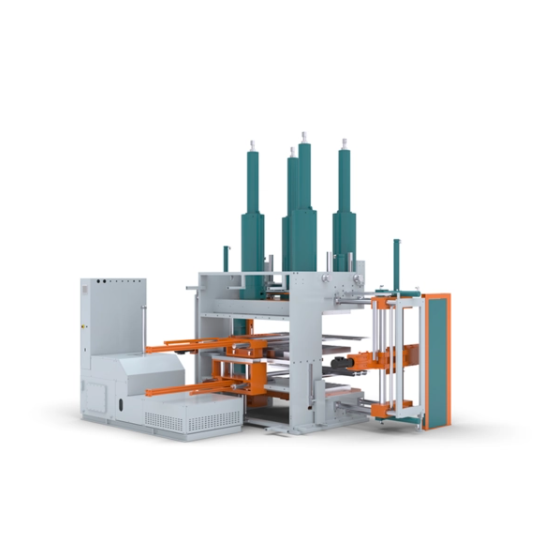
The Rubber Track Production Line from Dekuma is designed as a dedicated solution for construction, agricultural, and specialty vehicle rubber tracks. It integrates automated handling, demolding, and process control. The system is suitable for agriculture tracks, construction tracks, military tracks, and snowmobile tracks.
The production line features automated handling, smart monitoring, and an intelligent curing shutdown function designed to retain pressure while the main motor is stopped during long vulcanization cycles. These functions relate directly to the need for tighter production control. They allow process management to cover more than the press itself and connect curing with the wider production sequence.
Temperature Data Will Become More Useful for Production Decisions
For example, repeated temperature variation in the same mold area may indicate that the process needs inspection or adjustment. Production teams can compare temperature trends across track designs, rubber compounds, and curing recipes to investigate changes in curing stability. This makes the rubber track vulcanizing machine part of a broader process management system rather than an isolated piece of equipment.
The same principle applies to a rubber belt track vulcanizing machine. Over time, this can support more disciplined parameter management and reduce reliance on trial-and-error adjustments.
Continuous improvement will also depend on how clearly production data is interpreted. Equipment suppliers and manufacturers need to connect machine behavior with material performance, track structure, and production goals. Dekuma positions continuous iteration as part of its rubber track production approach, which fits this shift toward process-based manufacturing.
A More Controlled Direction for Track Manufacturing
Temperature uniformity will play a larger role as rubber track production becomes more automated and data-driven. Stable heating supports consistent curing, while monitoring and coordinated handling help production teams understand what happens during each cycle. The value comes from combining thermal control with process discipline rather than treating temperature as a single machine setting.
For B2B manufacturers, the next step is to evaluate curing equipment together with automation, monitoring, demolding, and production management. Better control across these areas can make rubber track manufacturing easier to study, adjust, and repeat as product requirements continue to change.